Airboat Noise, Hearing Protection and Access
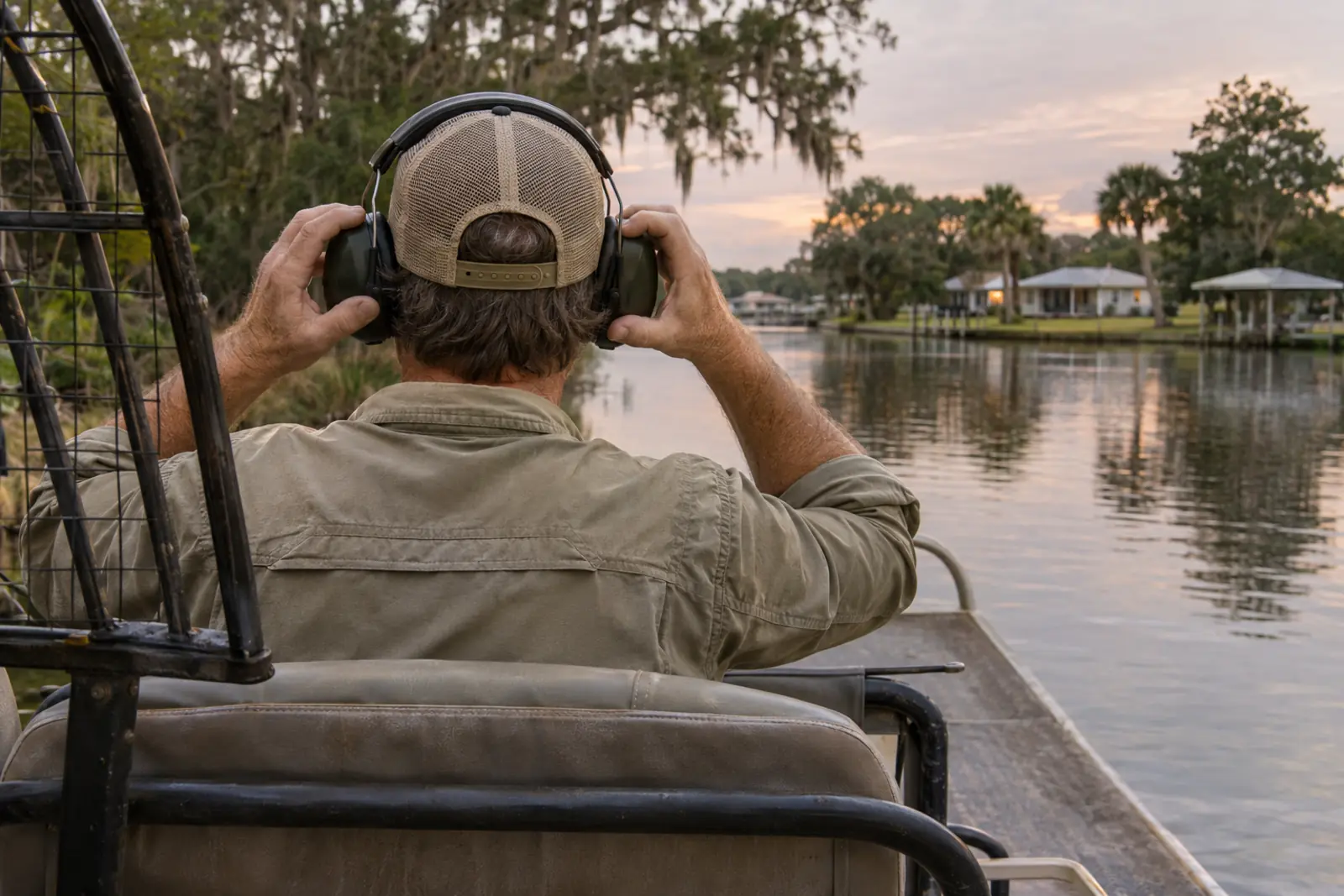
Airboats at running speed measure 100 to 110 decibels — above the threshold where permanent hearing damage begins in minutes without protection. That noise is also the reason every stretch of Florida water that has been closed to airboats was closed: resident complaints reach county commissions, and access shrinks.
Independent guide, not a club, dealer, outfitter or agency, and not affiliated with any organisation that previously used this domain. Rules on the water change — confirm anything legal with the Florida Fish and Wildlife Conservation Commission before you run.
How loud is an airboat?
At normal running speed, most airboats measure 100 to 110 dB(A). At full throttle, some designs reach 120 dB or higher. The propeller is the primary source: blade tips on a large prop can approach Mach 0.8, generating broadband noise that is both high in level and rich in low-frequency energy that carries far across open water. Engine exhaust contributes but is secondary.
For context, the National Institute for Occupational Safety and Health (NIOSH) recommends no more than 15 minutes of unprotected exposure at 100 dB before hearing damage risk becomes significant. At 85 dB — the level where long-term damage begins with repeated daily exposure — the safe unprotected limit is 8 hours.
Airboat ear protection: what to wear
Standard guidance for environments above 100 dB is dual protection: foam earplugs worn underneath over-ear earmuffs. When two devices are combined, the effective protection is roughly 5 dB above the higher-rated device alone — not the sum of both ratings.
- Foam earplugs alone — adequate for a brief one-time passenger ride, not for owners or regular runs.
- Passive earmuffs alone — insufficient at airboat noise levels; standard passive muffs do not block the low-frequency component that dominates propeller sound.
- Plugs under muffs — the minimum standard for anyone who runs regularly, and for all passengers on extended trips.
- Active noise reduction (ANR) headsets — electronics add low-frequency attenuation on top of the passive rating, directly targeting the propeller frequency range where passive protection falls short.
Noise-induced hearing loss is cumulative and irreversible. Fit matters as much as rating: a muff or plug that does not seal correctly provides substantially less than its stated NRR.
Florida's airboat noise law
Florida Statute 327.391, which took effect in 2006, requires every internal combustion engine on an airboat operated on Florida waters to be equipped with an automotive-style factory muffler, underwater exhaust, or another manufactured device capable of adequately muffling exhaust sound. Cutouts and flex pipe alone are prohibited. Violation is a noncriminal infraction; a cited operator cannot run the boat again until a compliant muffler is installed.
The muffler requirement covers exhaust noise only. Because the propeller generates most of an airboat's sound, even a fully compliant boat will typically exceed 90 dB at speed. Keeping the suppression system in good working order is both a legal obligation and a practical one — a cracked or missing exhaust component makes the problem noticeably worse. The airboat maintenance checklist includes what to inspect after each run.
Airboat noise ordinances: what counties can and cannot do
Under Florida Statute 327.65, counties may adopt additional vessel noise regulations, including a 90 dB(A) limit measured at 50 feet from the vessel.
That framework was tested in Alachua County, where a nighttime curfew ordinance prohibited airboat operation from 7 p.m. to 7 a.m. on area lakes. In December 2019, County Court Judge Kristine Van Vorst ruled the ordinance unconstitutional, finding it "conflicts with the Florida Statute by effectively setting the permissible decibel level to zero (0) as opposed to 90 dB A as permitted by Florida Statute, for a substantial period of time." Blanket curfews are difficult to sustain legally, but narrowly drawn noise limits consistent with the state standard remain possible — and resident pressure on commissions to pursue other access restrictions does not go away.
The habits that keep water open
Access is ultimately a political question. County commissions and legislators act on what they hear from constituents, and the loudest voices are almost always residents who live near the water, not the people running on it. The habits below cost nothing:
- Idle past houses, docks and anchored boats.
- Do not run residential stretches at dawn or after dark without reason.
- Keep the suppression system maintained and in place.
- Do not sit and rev at the ramp.
- Assume every pass near a house is a vote about your access.
Drivers who are still learning throttle control are the most likely to accelerate near residential stretches by mistake. The guide to driving an airboat for the first time covers how to manage speed transitions smoothly before you get near populated water.
Noise near wildlife areas and manatee zones
Noise concerns extend beyond residential neighbours. Protected areas in Citrus County include slow-speed manatee zones where engine behaviour is already regulated. Running loud near resting manatees or nesting birds draws attention from wildlife officers and environmental groups, both of whom can influence access decisions at the state level as well as locally. For a full list of zones and what each requires, see the guide to Citrus County manatee zones and refuges.
When you meet other water users
Paddlers, anglers and wildlife watchers share this water and are far more vulnerable to noise and wake than you are aboard. Slow early, pass wide, and come off plane before your wash reaches them, not after. Noise that feels manageable from inside the boat carries much further across open water than it seems from the helm.
Frequently Asked Questions
Are airboats loud?
Yes. At normal running speed, most airboats measure 100 to 110 dB(A) — in the range of a chainsaw or rock concert at close range. The noise comes mainly from the propeller, not the engine, so it cannot be fully reduced by a muffler alone.
How many decibels is an airboat?
Typical airboats measure 100 to 110 dB(A) at normal running speed, with some designs exceeding 120 dB at full throttle, depending on propeller size and tip speed, engine type and boat design. NIOSH recommends no more than 15 minutes of unprotected exposure at 100 dB before the risk of permanent hearing damage becomes significant.
What hearing protection do you need on an airboat?
The minimum for regular operators is dual protection: soft foam earplugs worn underneath over-ear earmuffs rated for high-noise environments. Passive muffs alone do not adequately block the low-frequency propeller noise. Active noise reduction (ANR) headsets add electronic attenuation of that low-frequency range and are the best option for anyone who runs frequently. Fit is critical regardless of which combination you choose.
Do Florida airboats have to have mufflers?
Yes. Florida Statute 327.391, in effect since 2006, requires all airboats on Florida waters to have an automotive-style factory muffler, underwater exhaust, or other manufactured device that adequately muffles exhaust. Cutouts and flex pipe alone are prohibited. An operator cited for a violation cannot run the boat until a compliant muffler is installed.
Can a Florida county ban airboats because of noise?
Not with a blanket curfew. Under Florida Statute 327.65, counties may adopt a 90 dB(A) limit measured at 50 feet. A nighttime curfew in Alachua County was struck down in 2019 because it effectively prohibited all operation rather than regulating sound levels. Targeted noise regulations aligned with the state standard remain legally viable.