Airboat Maintenance: What to Check After Every Run
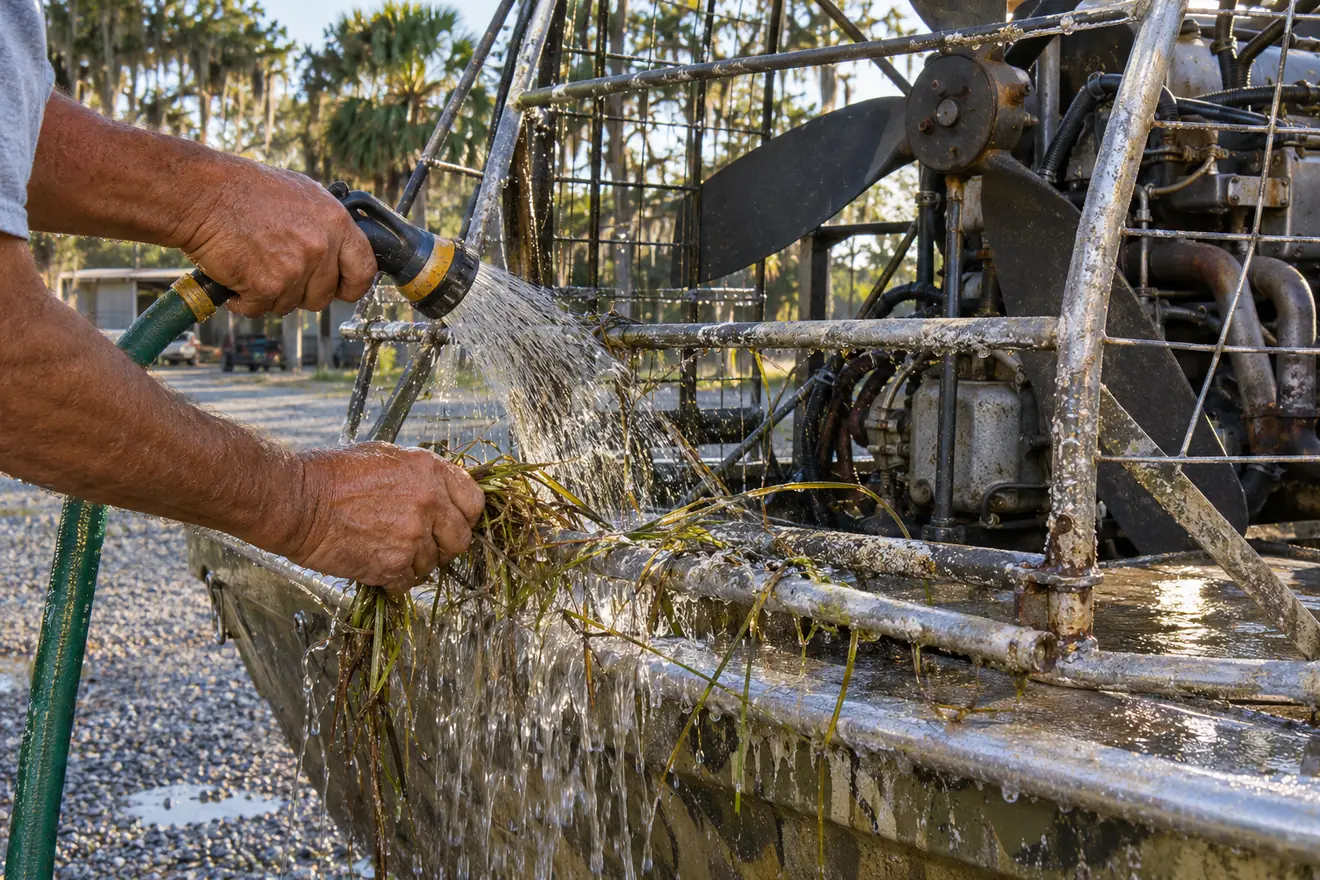
Regular airboat maintenance follows the environment more than the clock. What you ran through last weekend — salt marsh, hydrilla beds, sandy shallows — determines what the boat needs before the next trip, and in Citrus County those conditions vary enough that a consistent post-run habit matters more than any single service interval.
Independent guide, not a club, dealer, outfitter or agency, and not affiliated with any organisation that previously used this domain. Rules on the water change — confirm anything legal with the Florida Fish and Wildlife Conservation Commission before you run.
After every run
A five-minute walk-around after each trip catches most problems before they become expensive. If you are still building your post-run routine, the guide to how to drive an airboat for the first time covers pre-departure and return checks alongside the driving basics.
- Clear vegetation from the engine bay, the cage and the rudders. Grass packed against hot metal or caught in steering linkage holds moisture and causes corrosion; grass in a rudder cable can mask wear.
- Rinse thoroughly if you have been in salt or brackish water. A surface spray is not enough — see the salt water section below for what that actually requires.
- Inspect the propeller leading edges in good daylight. Look for new nicks, cracks and, on composite blades, any sign of delamination or blade separation. A fresh nick deepens under the centrifugal loads of a running prop.
- Check for new gouges in the hull polymer or cracks along aluminium weld seams.
- Wrench-check fasteners that have a history of vibrating loose on your boat, particularly cage mount hardware.
Airboat propeller maintenance
Run your fingers along the leading edges after every run rather than relying on a visual scan alone. On composite blades, feel for surface cracks, delamination along the blade face and any looseness at the hub. The PB Airboats service manual lists a propeller check — for nicks, cracks, separations and delamination — as part of every pre-operation inspection, not just scheduled service.
Blade track — how precisely all blades sweep through the same plane — affects vibration loads on the gearbox and engine mounts. A prop that feels rougher than usual, or one that has taken a solid hit, should be checked for track. Measuring and correcting track is a shop task. Repairing a nicked composite leading edge is possible if the damage is caught early; delaminated blades are not field-repairable and should not be run. When evaluating a used airboat, the guide to buying an airboat covers propeller and hull condition as part of the pre-purchase inspection.
Airboat fuel system
Most pump gas in Florida contains up to 10 percent ethanol. Ethanol is hygroscopic — it draws moisture from the humid Florida air into the tank and can cause phase separation, where a water-and-ethanol layer settles to the bottom right where the fuel pickup draws. The result is hard starting, rough running and, over time, damage to carburettors, injectors and older rubber fuel lines. Ethanol-free fuel, available at many Florida marinas, is the better choice for any airboat that sits between uses.
Inspect fuel lines for stiffness, surface hazing or cracks; a rubber line degraded by ethanol can shed debris internally into the fuel system. According to the PB Airboats service manual, the fuel filter should be replaced every 50 hours of operation or every 3 months. A water/fuel separator in the line is a sensible addition on any boat running Florida's coastal waters. For aircraft-engined airboats, verify the correct fuel grade with the engine manufacturer — many require aviation gasoline (Avgas), not pump gas.
Salt water: why a rinse is not enough
Salt crystals left in seams, crevices and around fittings are hygroscopic — they continue drawing moisture from the air and maintain corrosive conditions even after the boat looks dry, as detailed in Rogue Jet Boats' guide to post-saltwater aluminium boat care. A quick spray over the hull removes loose surface salt but leaves crystallised deposits behind in the places where corrosion starts.
Rinse the whole boat the same day, including up inside the engine bay, around the cage rigging, all hardware and the trailer. Pay particular attention to weld seams, chines, electrical terminals and anywhere dissimilar metals meet. Salt water increases electrical conductivity and accelerates galvanic corrosion wherever aluminium contacts stainless steel or other metals — a problem that starts invisibly and surfaces as expensive structural damage. Rinse trailer hubs and brake components as well. For regular saltwater use, follow the freshwater rinse with a salt-removing detergent formulated to dissolve crystallised deposits, not just float off surface residue.
Airboat maintenance schedule
The PB Airboats service manual, one of the more detailed publicly available guides for production airboats, lists the following baseline intervals:
- Every 10 hours: wrench-check all fasteners; check engine oil and coolant level; oil steering cable ends; lubricate rod-end fittings.
- Every 50 hours or 3 months: change engine oil and filter; change gearbox oil (75W140 for most belt-drive reduction units); inspect rod-ends and steering bushings for wear; check and adjust engine accessory drive belts; clean the engine intake spark arrestor; replace the fuel filter.
- Every 100 hours or annually: replace spark plugs and wires; full fuel system inspection.
- Every 200 hours: replace motor mount bushings, exhaust band clamps and exhaust flex-pipe.
- Every 500 hours or 5 years: replace the drive belt on the reduction unit, steering cable, throttle cable, coolant hoses and fuel hoses.
Most automotive-engined airboats call for 92 octane fuel or greater. Check your engine manufacturer's intervals alongside the airboat builder's — they sometimes differ, and the more conservative schedule is the one to follow.
The PB Airboats schedule calls for inspecting and adjusting drive belts at every 50-hour service and replacing the belt on the reduction unit at 500 hours or 5 years. A belt that is running out of adjustment or showing obvious wear is worth correcting before the next run rather than monitoring.
Cage and mount welds deserve a deliberate inspection at regular intervals — clean the boat first so you can see the welds clearly. The cage is a life-safety structure; a cracked weld is a shop visit, not a watch item. For how cage condition fits into the broader picture, see the airboat safety guide.
Airboat storage
Ethanol-blended fuel left standing in a hot Florida tank can begin to degrade within a few weeks, leaving varnish and gum deposits in the carburettor or injectors. Add a marine fuel stabiliser before any storage period of that length, then give the engine a short run to circulate the treated fuel through the whole system.
Cover the boat so rain does not pool in the bilge or on seats. Keep rodents out of the engine bay — wiring harnesses and fuel lines are common targets in stored boats. Put it away clean: vegetation left against aluminium traps moisture and causes corrosion even under a cover. Florida does not follow a traditional winterising calendar; if you plan to leave the boat idle between seasons, the guide to seasons and water conditions covers how water levels and weather cycles affect when most Citrus County owners are on the water.
What to leave to a shop
Propeller balancing and track correction, gearbox internals, engine work beyond routine service and filter changes, and all welding on the cage. If a cage weld looks questionable, do not run the boat until a qualified welder has examined it. The cage is a life-safety structure and there is no field fix for a cracked weld.
Frequently Asked Questions
How often should I change the gearbox oil on an airboat?
The PB Airboats service manual recommends changing gearbox oil every 50 hours of operation or every 3 months, whichever comes first. The correct grade for most belt-drive reduction units is 75W140 gear oil. Check your specific gearbox manufacturer's specification — some units have different requirements — and use the more conservative of the two intervals if they differ.
Is a freshwater rinse enough after running in salt water?
No. A rinse removes loose surface salt but leaves crystallised deposits behind in seams, crevices and around fittings. Those crystals keep pulling moisture from the air and continue corroding metal even after the boat looks dry. A thorough rinse reaching inside the engine bay and all hardware, followed by a salt-removing detergent for regular saltwater use, gives meaningfully better protection than a surface spray.
How do I know if an airboat propeller needs repair or replacement?
Inspect the leading edges after every run for nicks, cracks and, on composite blades, any delamination or blade separation. Small leading-edge nicks can often be repaired by the propeller manufacturer if caught early; a blade showing significant delamination or structural damage should not be run. New or worsening vibration is another sign that a prop or balance issue needs shop attention rather than monitoring.
What fuel should I use in a Florida airboat?
Most automotive-engined airboats call for 92 octane or greater. Because most Florida pump gas contains up to 10 percent ethanol — which attracts moisture and degrades older rubber fuel components — ethanol-free fuel available at many Florida marinas is the better choice for any boat that sits between uses. Aircraft-engined airboats typically require aviation gasoline; confirm the correct grade with your engine manufacturer before you fill the tank.
How long can an airboat sit without being run in Florida?
Untreated ethanol-blended fuel can begin to degrade within a few weeks in Florida's heat and humidity. Add a marine fuel stabiliser before any storage period of that length and give the engine a short run after adding it so the treated fuel reaches every part of the system. For shorter gaps between uses, the priorities are keeping the boat clean, dry and covered so vegetation and moisture do not work against the hull while it sits.