Florida Airboat Operator Course: Who Needs It and How to Find One
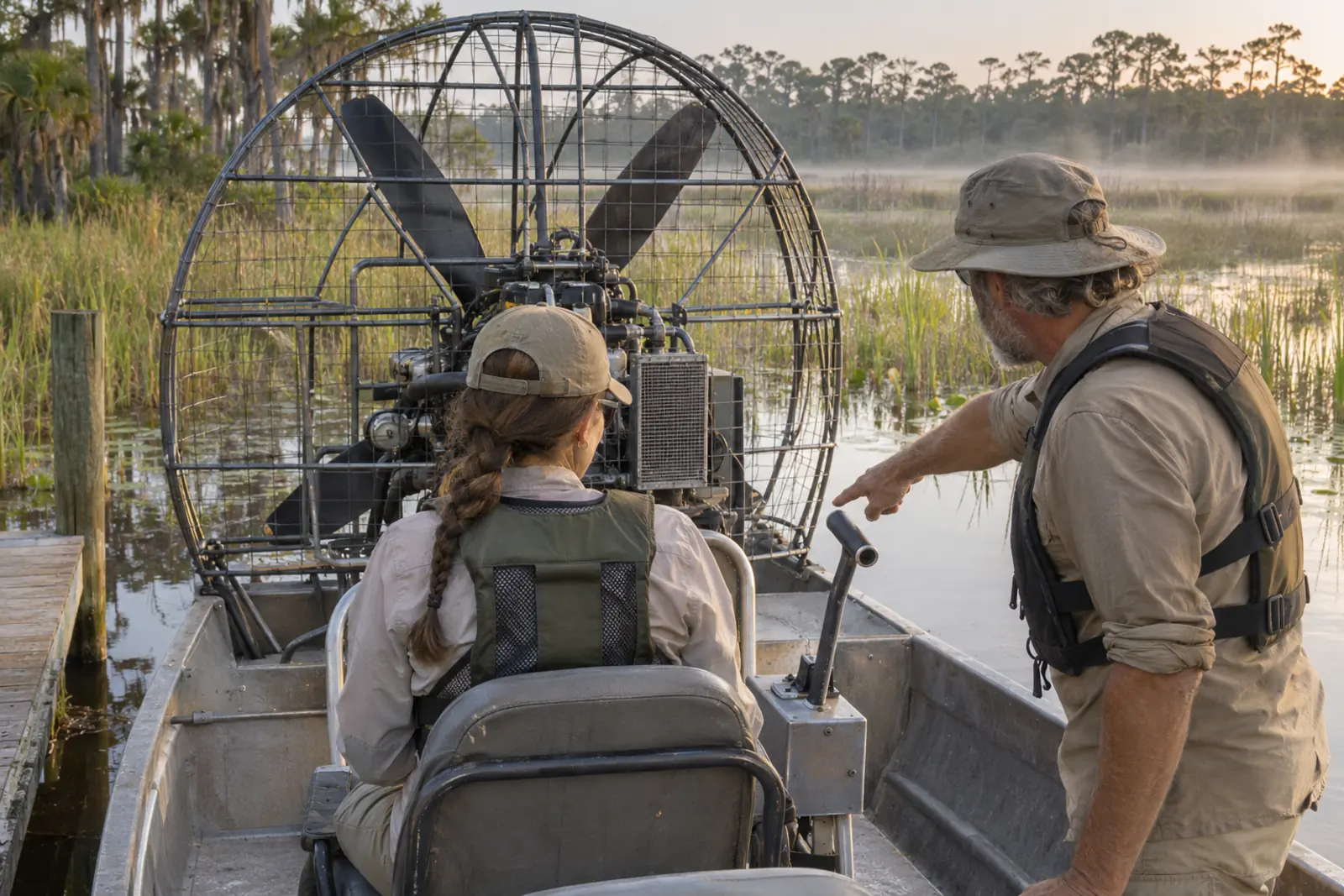
Few questions generate more confusion among new airboat owners on the Nature Coast than this one: does Florida require a special course before you can run an airboat, and if so, who exactly does it apply to? The honest answer is that you may need two separate credentials, and treating them as interchangeable can leave an operator either unknowingly out of compliance on the water or unaware that a third layer of federal licensing applies if money ever changes hands for a passenger trip. This guide untangles Florida's airboat operator course requirement from the state's broader boating safety education program, explains when a U.S. Coast Guard captain's license enters the picture, walks through what an FWC-approved course actually covers, and shows where to find a current list of approved providers serving Citrus County and the surrounding Nature Coast.
Two Requirements, Not One
Florida regulates airboat operators through two distinct legal tracks that are not interchangeable. The first is the Florida Boating Safety Education requirement, which applies broadly to motorized vessel operators under a certain birth-year threshold and is administered through Florida Statute s. 327.395. The second is the Airboat Operator Course requirement, which targets a narrower group of operators on specific designated water bodies and is governed by Florida Statute s. 327.391 together with Florida Administrative Code Rule 68D-35.001.
Completing one does not satisfy the other. An operator who holds a Florida Boating Safety Education ID card but has not completed the airboat course is still non-compliant if the airboat course applies to their situation - and vice versa. Understanding which requirement applies to you begins with knowing what each one covers, who each one targets, and how they relate to each other without overlapping.
For a broader overview of the licensing and registration framework that governs airboats in Citrus County, the Florida Airboat License, Registration and Rules page on this site provides the full picture of what is required before an airboat leaves the ramp.
Who the Airboat Operator Course Applies To
Florida Statute s. 327.391 creates a specific mandate for airboat operators on certain designated waters. The law identifies classes of waterways where the airboat's combination of shallow-draft capability, elevated speed, and high-decibel prop wash creates particular hazards for wildlife, other waterway users, and the operators themselves. On those designated waters, completing an FWC-approved airboat operator course is not optional - it is a legal prerequisite for getting behind the controls.
The practical question for anyone who runs an airboat on the Nature Coast is whether the specific water bodies they use fall under the statute's scope. Citrus County's interconnected system of rivers, springs, bays, and tidal creeks - including Crystal River, Kings Bay, the Chassahowitzka River, and stretches of the Withlacoochee River - includes waters that fall within FWC's regulated areas. Because the designated list can be amended through the administrative rulemaking process, operators should not rely on secondhand information or old permit paperwork to determine applicability. The current list of designated waters is maintained by the Florida Fish and Wildlife Conservation Commission at myfwc.com, and that is the authoritative source to check before your first run on any new waterway in this region.
Exemptions exist in the statute, though they are narrow. Commercial operators who already hold a valid U.S. Coast Guard Merchant Mariner Credential with an appropriate airboat endorsement may qualify for recognition of that credential. Law enforcement officers operating in an official capacity are also generally exempt. Everyone else operating an airboat on a designated water body is expected to hold the course completion credential. The statute does not carve out exceptions for experience level, long tenure as an airboat operator, age beyond the minor-age thresholds addressed elsewhere in Chapter 327, or how frequently the operator uses a particular waterway.
One point that frequently surprises operators: the requirement attaches to the operator, not to the vessel. Registering the airboat in Citrus County, displaying current registration decals, and paying all applicable vessel fees does not satisfy the operator course requirement. The course completion certificate is a personal credential that follows the individual, not the hull. Two different people can operate the same registered airboat, and each of them bears the individual obligation to hold the credential if the designated-waters rule applies to them.
The Florida Boating Safety Education ID Card
Separate from the airboat-specific course, Florida law requires most motorized vessel operators to hold a Florida Boating Safety Education ID card. Under Florida Statute s. 327.395, any person born on or after January 1, 1988 who operates a vessel powered by a motor of 10 horsepower or more on Florida waters must carry this card. Because virtually every airboat on the Nature Coast exceeds 10 horsepower by an order of magnitude, the ID card requirement applies to any operator in that birth-year bracket regardless of vessel type.
The card is obtained by completing an FWC-approved boating safety course and passing the associated examination. Courses are offered in several formats: classroom sessions run by FWC-authorized instructors, state-park programs, and online courses that meet the National Association of State Boating Law Administrators (NASBLA) standards. FWC maintains a searchable list of approved course providers on its website. The card itself is issued after the provider verifies course completion and exam passage. Under current Florida law the card carries no expiration date, though operators should verify this remains unchanged at myfwc.com, since Chapter 327 is revised periodically.
The key distinction from the airboat operator course: the boating safety ID card course is a general maritime education program covering hull types, navigation rules, weather assessment, and emergency procedures for all vessel categories. It does not address airboat-specific handling, the physics of propeller-thrust steering on a hull with no submerged rudder, vegetation navigation, or the shallow-water wildlife hazards that define Nature Coast airboating in any depth comparable to what an airboat operator genuinely needs. The FWC designed the airboat course precisely to fill that gap.
Operators born before January 1, 1988 are not required to carry the boating safety ID card under current Florida law, but they are still subject to any applicable airboat operator course mandate under s. 327.391 if they operate on designated waters. Age provides no general exemption from the airboat course requirement.
Passengers for Hire: When You Need a Captain's License
A third layer of credentialing applies to anyone who charges money, in any form, for taking passengers on an airboat. Florida and federal law treat the exchange of compensation as a threshold that triggers commercial vessel regulations, and those regulations require a U.S. Coast Guard-issued license entirely separate from either the boating safety ID card or the state airboat operator course.
The relevant federal credential is the Operator of Uninspected Passenger Vessels (OUPV) license, commonly called the "Six-Pack" license because it authorizes carrying up to six paying passengers on an uninspected vessel in waters within its scope. Obtaining an OUPV license requires logging a minimum of 360 days of sea service, of which 90 days must be on the category of water where the applicant intends to operate - near-coastal, inland, or rivers and lakes. Applicants must also pass a Coast Guard-approved written examination, complete CPR and first-aid certification, pass a physical examination, and clear a background check tied to the Transportation Worker Identification Credential (TWIC) program. Drug testing under Coast Guard chemical-testing regulations is mandatory.
The Coast Guard's National Maritime Center processes OUPV applications and maintains the exam schedule and fee information. Because both fees and sea-service documentation requirements are subject to revision, the NMC website is the place to verify current standards before beginning the application process rather than relying on information passed between operators at the ramp.
For Citrus County, the practical implication is straightforward: anyone advertising airboat tours, charging for guided trips, or accepting any payment in exchange for transporting passengers on an airboat is operating in federal commercial vessel territory. Holding only the state airboat operator course completion card is not sufficient. The reverse is equally true - holding a USCG captain's license does not automatically exempt an operator from Florida's airboat operator course requirement under s. 327.391. These are separate legal regimes with separate purposes, and both must be in order before a commercial airboat trip launches from a Citrus County ramp.
The Airboat Tours in Citrus County: How to Choose One page on this site explains what credentials a reputable commercial operator should hold and what questions to ask when evaluating tour options.
What an FWC-Approved Airboat Course Covers
The Florida Fish and Wildlife Conservation Commission sets minimum content standards for any course it approves under Rule 68D-35.001. While individual providers may organize their materials differently or supplement with locally relevant content, all FWC-approved airboat courses must address a core set of competencies. Understanding what those competencies are helps operators evaluate providers and helps anyone undecided about whether to take the course appreciate its practical value beyond mere legal compliance.
Airboat mechanics and propulsion. An airboat is steered by directing thrust from an aircraft-style propeller, not by a submerged rudder. This means the vessel does not respond to steering inputs the way a conventional powerboat does, and it has essentially no active braking capability - stopping distance is a function of vegetation drag and open-water friction, not a throttle response. FWC-approved courses cover how the propulsion system works, how throttle changes affect directional control, and the difference in steering response between low-speed and higher-speed operation when prop wash interacts differently with the rudder surfaces.
Shallow-water navigation. Citrus County's tidal marshes and spring-fed rivers are shallow by definition, and reading the water surface for submerged hazards, vegetation density, and mud-bottom variations is a skill that cannot be fully learned from a manual. Approved courses cover how to interpret vegetation patterns as depth indicators, how to handle the bow-low running attitude that places the operator closer to obstacles than their elevated seat position suggests, and how to manage speed near structure when there is no prop-in-water response to alert the operator to contact.
Wildlife awareness and legal obligations. The Nature Coast is manatee habitat, osprey nesting territory, bald eagle country, and alligator water. FWC-approved courses cover minimum safe distances from protected species, the federal and state penalties that apply to harassing or striking a manatee, and the speed zone and idle-speed mandates in force within the Crystal River and Kings Bay designated protection areas. This content overlaps with and deepens the material covered in the site's airboat safety page, which provides additional context on wildlife encounters and hearing protection for Nature Coast conditions.
Personal flotation devices and required safety equipment. Federal carriage requirements for life jackets by vessel length, the distinction between throwable devices and wearable PFDs, flare requirements for vessels operating at night, and fire extinguisher specifications are all standard content in an approved course. Airboats present a specific PFD challenge: the high-velocity prop wash generated during a capsize or rollover scenario can make a conventional life jacket a hazard rather than a protection in certain circumstances - a nuance that general boating safety courses do not address in airboat-specific terms.
Florida-specific regulations. This includes vessel registration and titling requirements, the inspection authority of FWC officers, and the administrative framework for designated airboat zones in areas like the Chassahowitzka National Wildlife Refuge and the Crystal River National Wildlife Refuge, both of which include or border waterways in Citrus County. Understanding where zone boundaries fall and how they interact with speed and noise restrictions is directly relevant to daily operation on Nature Coast waters.
Emergency procedures. Capsize recovery, man-overboard protocols on a vessel that cannot quickly reverse course, engine-out procedures in dense vegetation, and the communication process for calling for assistance round out the safety content of a typical approved course. These scenarios have genuine probability on shallow, fast-moving water far from a developed ramp, and rehearsing them in a low-stakes instructional setting creates the mental framework an operator needs when a problem occurs in the field.
Course length varies by provider, but most approved programs run between four and eight hours of instruction, combining classroom or online material with a practical component on the water. Operators planning to take a course should ask providers specifically whether the program includes a water component, as that hands-on element is valuable and not every format offers it.
How to Find an Approved Provider Near Citrus County
The Florida Fish and Wildlife Conservation Commission maintains the definitive list of approved airboat operator course providers. The search tool is accessible through the boating section of myfwc.com. Searching by county or by region allows an operator to identify providers who either operate locally or who offer online course components that can be completed before traveling to Citrus County for a water session.
When evaluating a provider, several factors are worth confirming before enrolling:
- Current FWC approval status. Approvals are issued for specific time periods and are subject to renewal. Ask the provider for their current FWC approval number and verify it against the FWC list before paying any enrollment fee. A provider whose approval has lapsed cannot issue a legally valid course completion certificate, and an invalid certificate will not satisfy the requirement during a field inspection.
- Practical component availability. If the program is entirely online or classroom-based, ask whether a water skills session is offered as a supplement. For operators new to airboating, theoretical knowledge from a classroom is necessary but not sufficient for safe operation on Nature Coast waterways where shallow draft, narrow channels, and manatee habitat demand practiced instincts.
- Local knowledge depth. A provider based in or regularly operating on Citrus County waters will carry direct knowledge of the Crystal River manatee refuges, the Chassahowitzka approach channels, the tidal timing of the Withlacoochee flats, and the specific vegetation patterns that challenge operators on those particular grounds. That local grounding makes course content more directly applicable than instruction oriented toward inland prairie marshes or the Everglades, which share principles but differ substantially in environment.
- Completion certificate format. Florida officers enforcing the airboat course requirement will ask to see the completion certificate. Confirm that the certificate the provider issues clearly identifies the course name, the approving authority, the completion date, and the operator's full legal name. Laminated wallet cards and printed certificates are both common formats; ask in advance what form the credential takes and how to store it so it survives the spray and weather exposure typical of an airboat run.
Beyond FWC's official list, some Citrus County operators have found providers through the Florida Airboat Association (floridaairboat.org), a statewide advocacy organization that tracks regulatory developments affecting airboat operators and can point members toward local course options. FWC's Southwest Region office, which covers Citrus County enforcement and regulatory matters, can also provide referrals to current approved providers operating in the area. Contact information for FWC regional offices is available through the main FWC website.
Pricing varies considerably by provider and format. Online-only programs tend to cost less than full-day courses with a water component. Because course fees are set independently by each provider and change without notice, no specific prices are cited here - check directly with providers for current enrollment costs before budgeting for the credential.
Documents to Carry on Every Run
Florida law requires that certain documents be aboard or immediately accessible during vessel operation. For an airboat on Citrus County waters, the complete documentation package typically includes the following items. Where a document has not been issued because the underlying requirement genuinely does not apply, the operator should understand clearly why they are exempt rather than simply leaving the gap in their on-water records.
- Vessel registration card. The original registration card for the airboat must be aboard. Florida requires all motorized vessels operating on public waters to be registered with the Florida Department of Highway Safety and Motor Vehicles, and the registration card is the proof of that registration. A photocopy is not an acceptable substitute for the original during a field inspection.
- Florida Boating Safety Education ID card (required if the operator was born on or after January 1, 1988). The card must be in the operator's possession during operation - kept on the vessel or on the operator's person. FWC officers may ask to see it at any time, and "it's at home" is not a compliant answer on the water.
- Airboat operator course completion certificate. On waters designated under s. 327.391, the course completion card or certificate must be available for inspection. Some operators keep a laminated copy aboard the vessel and store the original in a dry, secure location onshore. Confirm with the issuing provider and with current FWC guidance what format is acceptable for a field inspection, since officer expectations can vary by region.
- USCG OUPV license (required if taking paying passengers). The original credential must be aboard any vessel operating under a commercial passenger charter. Both Coast Guard officers and FWC officers have authority to request it, and operating commercially without it aboard is a federal violation separate from any state regulatory matter.
- Valid government-issued photo identification. While not strictly a vessel document, FWC officers conducting safety inspections routinely ask for the operator's ID to cross-reference against registration and license records. Having it accessible on the water avoids a preventable complication.
Storing these documents in a waterproof container or dry bag is a practical precaution on any airboat that operates in open tidal water or through spray conditions. A document wallet saturated by an unexpected afternoon squall in the Gulf lowlands is a preventable problem with a simple solution.
Where to Confirm the Current Rule
Florida's airboat regulations have evolved significantly over the past two decades, and that evolution is not finished. The Florida Legislature and the FWC rulemaking process can modify the list of designated water bodies, adjust course content requirements, and change exemption criteria between legislative sessions or administrative rule cycles. Any information about specific designated waters, course requirements, or exemption thresholds should be verified at primary sources rather than treated as settled because it appeared in a forum post or a conversation at the ramp.
The authoritative sources for current requirements are:
- myfwc.com - the Florida Fish and Wildlife Conservation Commission's official website, which maintains the current approved course provider list, the designated waters list under s. 327.391, and interpretive guidance on the airboat rules.
- leg.state.fl.us - the Florida Legislature's online statutes database, where the current enrolled text of s. 327.391, s. 327.395, and related provisions of Chapter 327 can be read in full without editorial interpretation.
- flrules.org - the Florida Administrative Code and Florida Administrative Register, where FWC Rule 68D-35.001 and any pending amendments to it are published and publicly accessible.
- FWC Southwest Region office - FWC's regional staff handle Citrus County enforcement and regulatory matters and can answer operator-specific questions about applicability to particular waterways. Contact information is available through myfwc.com.
The rules and licensing overview on this site provides additional context for how the airboat course fits within Florida's broader vessel regulation framework, including vessel registration timelines, titling requirements, and the age-based operator restrictions that run parallel to the course mandate.
Frequently Asked Questions
Does passing the Florida Boating Safety Education course count as completing the airboat operator course?
No. The Florida Boating Safety Education ID card and the FWC-approved airboat operator course are distinct requirements created by different statutes. Completing one does not satisfy the other. If both requirements apply to you - for example, you were born after January 1, 1988 and you operate on a designated water body - you need both credentials. The boating safety course covers general vessel operation across all hull types, while the airboat course covers airboat-specific handling, wildlife obligations, and the regulations specific to Florida's shallow-water airboat environments.
How long does an FWC-approved airboat operator course typically take?
Course length varies by provider and format. Most approved programs require between four and eight hours of total instruction time, divided between a knowledge component and, in many programs, a practical water session. Online-only formats can be completed at the learner's own pace, while in-person full-day courses condense all material into a single session. When selecting a provider, ask specifically about total hours, whether a practical component is included, and what format the final exam takes - then verify those claims against FWC's approval documentation for that provider.
I already have a USCG captain's license. Do I still need the FWC airboat operator course?
In most cases, yes. The USCG Operator of Uninspected Passenger Vessels credential is a federal commercial license that authorizes carrying paying passengers. Florida's airboat operator course is a state safety education requirement that applies to operators on designated water bodies regardless of whether they carry passengers for hire. The two credentials address different regulatory concerns and do not substitute for each other under current Florida law. An exception may exist for operators holding a Merchant Mariner Credential with a specific airboat endorsement - verify the current exemption language directly with FWC before assuming it covers your situation.
What penalties apply for operating an airboat without the required course completion?
Operating an airboat on a designated water body without a valid course completion certificate is a noncriminal infraction under Chapter 327, punishable by a civil fine. The specific fine amount is set by statute and may be adjusted over time, so verify the current penalty schedule at leg.state.fl.us or myfwc.com rather than relying on figures passed along by other operators. Beyond the fine, an officer may require the vessel to return to the ramp immediately, ending any trip already underway regardless of conditions or distance from the launch.
Is the airboat operator course required if I only run on private property?
Florida's airboat course requirement under s. 327.391 applies to the "public waters of this state," so entirely private water bodies that are not connected to navigable public waters fall outside the statute's reach. However, the boundary between private and public water in Florida is legally complex, and many waterways that appear private carry public navigability status under Florida common law or the public trust doctrine. If there is any doubt about whether a specific body of water qualifies as a public water, consulting an attorney familiar with Florida water law or contacting FWC directly is the prudent step before assuming the exemption applies.
Can the airboat operator course be completed entirely online?
Some FWC-approved providers offer online course formats that satisfy the knowledge and examination portions of the requirement. Before enrolling, verify with the specific provider and with FWC that the online format they offer produces a fully compliant completion certificate for the designated waters where you intend to operate. Some providers combine an online knowledge component with a mandatory in-water practical session before issuing the certificate. For operators new to Nature Coast waterways, programs that include a practical water component provide preparation that no online format can fully replicate - Crystal River's tidal flats and the Chassahowitzka's narrow creek channels reward hands-on time in a way that screen-based instruction cannot match.