How to Drive an Airboat for the First Time
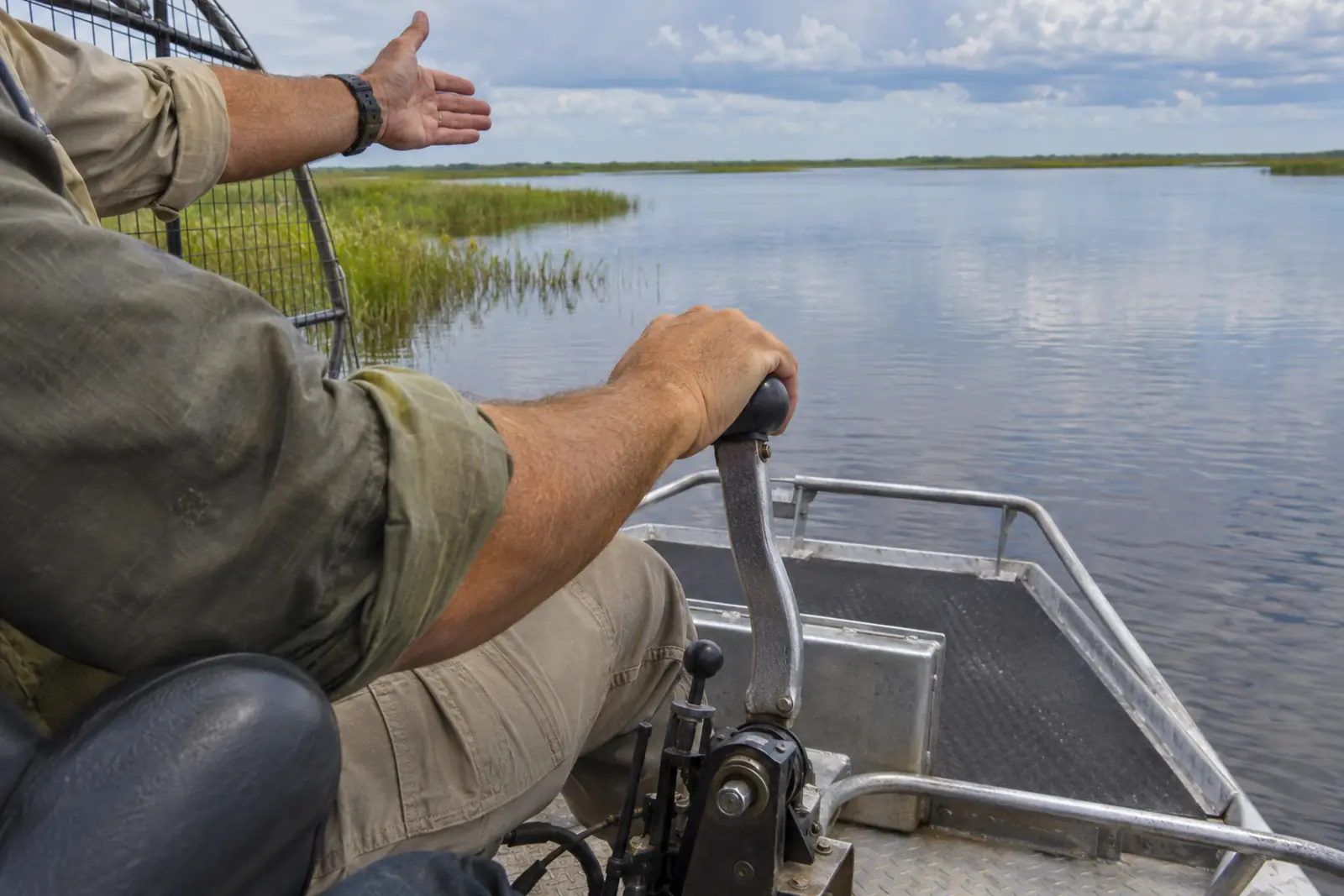
An airboat has no brakes, no reverse worth the name, and no grip in the water. Everything that surprises new drivers follows from those three facts.
Independent guide, not a club, dealer, outfitter or agency, and not affiliated with any organisation that previously used this domain. Rules on the water change — confirm anything legal with the Florida Fish and Wildlife Conservation Commission before you run.
The controls
The throttle is a foot pedal under your right foot: press it to spin the propeller faster and push the boat forward. The control stick is in your left hand: push it forward to turn right, pull it back to turn left. Those two inputs are everything. There is no brake pedal and no reverse gear.
How to drive an airboat: steering with the throttle
The rudders sit directly in the propeller's airstream. At idle, barely any air flows over them and you have almost no steering authority. The instinctive response to a sudden hazard — cut the throttle — is exactly what removes your ability to turn at the worst possible moment. Learning to steer with throttle, using short blips on a deflected stick to change heading without adding much forward speed, is the central skill of airboat driving.
Getting on plane
From a standing start on water, apply full throttle until the hull lifts onto the step and begins to skim the surface. Once on plane you can ease back to a comfortable cruise speed. On land, apply steady throttle to get moving, then drop to a walking pace while manoeuvring — the PB Airboats operator manual recommends no more than 5 mph during turns on land to avoid rollover.
It slides
A turn at speed is a controlled slide, not a carve. The boat rotates and then travels in the new direction. Move the stick gradually — forcing it sharply while on plane can cause the hull to hop or dig a rail, which can roll the boat. On grass this is normal and useful; on open water beside a dock, the slide is how people hit things.
Stopping
You stop by running out of momentum. Ease the throttle back progressively and in a straight line; cutting power suddenly while still moving at speed can allow the trailing wake to catch up and wash over the stern. Plan your approach from much further out than feels necessary, and never commit to a hard object with speed you cannot shed in time.
Weight matters
Where people sit changes how the boat gets on plane, how it turns and how it crosses vegetation. Brief everyone before you leave the ramp to stay seated and not to shift weight in turns — this matters from the moment the hull starts to move.
Ear protection
Airboat engines are extremely loud at full throttle. Wear proper earmuffs or earplugs on every run and supply them to every passenger. The guide on airboat noise, hearing protection and access covers equipment options and local rules in more detail.
Practise deliberately
- Stops from moderate speed, noting the distance the boat needs to coast to a halt.
- Turns both directions using throttle blips rather than momentum, in open water first.
- Getting on and off plane on flat water before you attempt vegetation.
- Transitions from water to grass and back, at low speed before high speed.
- An engine-off drift and restart in open water, before you need it for real.
For a broader overview of what goes wrong and how to reduce exposure, the guide on airboat safety and common hazards is worth reading before your first solo run.
Florida training and licensing
Operators carrying passengers for hire must comply with Florida Statute 327.391, which requires proof of a commission-approved airboat operator course, CPR and first-aid training, and a boater education certificate. Even outside that requirement, formal instruction compresses the learning curve significantly. The full picture is in the guide to Florida airboat licensing, registration and rules.
Get taught
Read what you like — the useful version of this comes from hours in the seat next to someone competent. Find that before you buy a boat, not after. Airboat tours in Citrus County let you watch an experienced operator handle local water, vegetation and tidal conditions before you commit to ownership.
Frequently Asked Questions
Do airboats have brakes or reverse?
Standard airboats have neither. Slowing down depends entirely on reducing throttle and letting friction bleed off momentum. Plan every approach as though you will coast to a stop, because that is exactly what will happen.
How hard is it to learn to drive an airboat?
The basic controls — throttle pedal and stick — take minutes to understand. Developing the feel for throttle-dependent steering, judging stopping distances and managing turns in tight spaces takes considerably longer. Experienced operators describe the full skill as instinctive only after many hours of seat time; expect competence in open water well before you are comfortable in confined channels.
Can airboats tip over?
Yes. Rollovers happen most often from too much speed in a sharp turn, particularly on land where the hull has less lateral support. If the boat begins to hop in a turn, straighten out and reduce speed before trying again. The 5 mph limit on land turns is not a suggestion.
Do you need a licence to drive an airboat in Florida?
Florida Statute 327.391 sets out requirements specifically for operators taking passengers for hire, including completion of a commission-approved airboat operator course, CPR and first-aid training, and a boater education certificate. For the complete picture on what applies to recreational use, see the guide to Florida airboat licensing, registration and rules, and confirm current requirements with the Florida Fish and Wildlife Conservation Commission before you run.
How do you stop an airboat safely?
Reduce throttle gradually and in a straight line, well before you reach your target. Avoid cutting power abruptly while still at speed — the boat's trailing wake can catch up and wash over the stern. Begin slowing well before the point that feels necessary until you have calibrated the stopping run for your specific boat and load.